 Spain · Europe
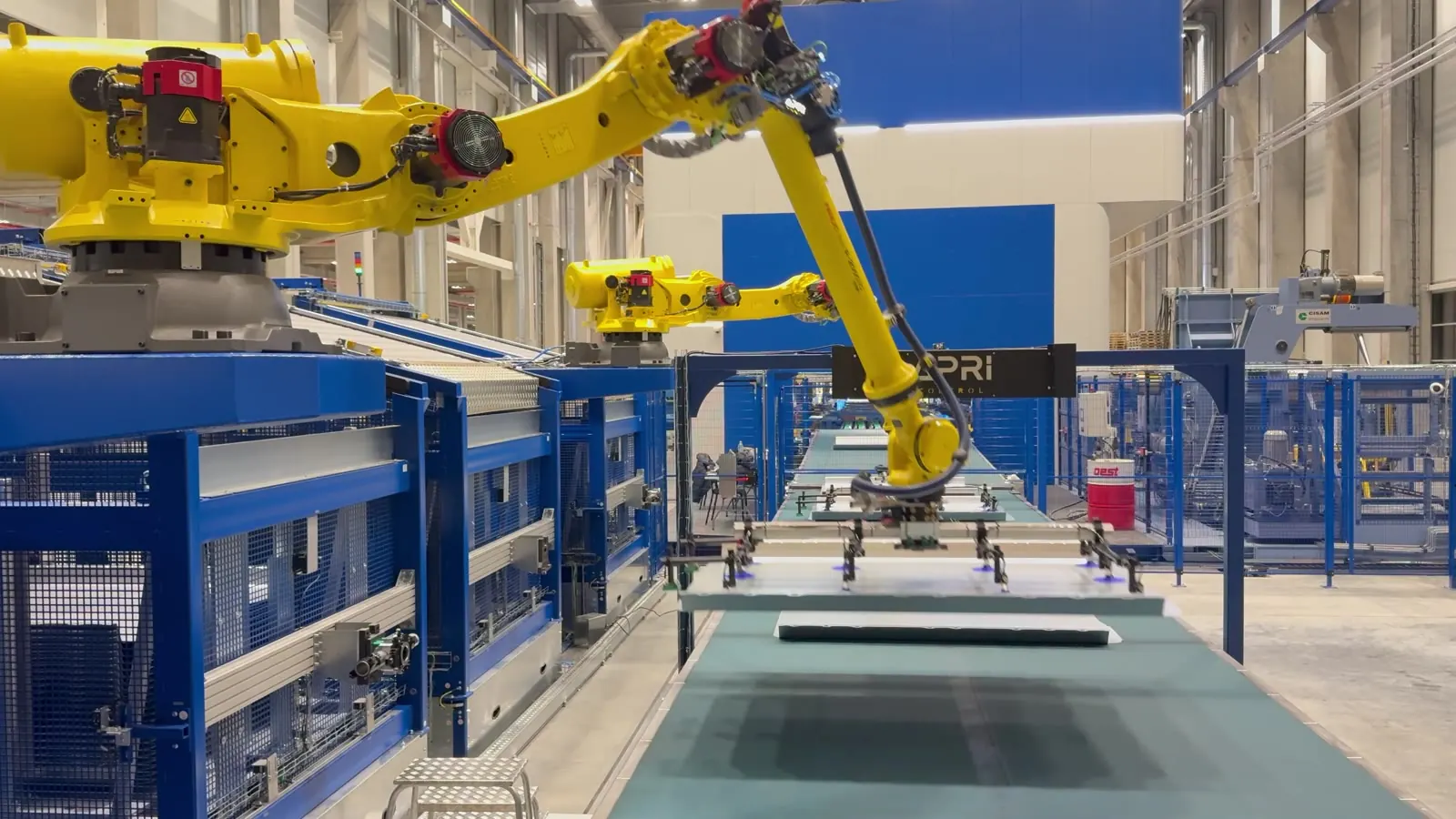
Two ways to take parts off the line
Stacking: the robot places parts on top of each other in a container or on a pallet. It works for parts that can rest on each other without marking: reinforcements, brackets, structural parts or nesting parts.
Racking: the robot places each part in a fixed position in a rack, separate from the others. This is the norm for class-A surface panels and large parts that would deform or scratch if stacked.
What decides between them
| Criterion | Stacking | Racking |
|---|---|---|
| Surface | Hidden or structural part | Class-A surface part |
| Container | Pallet or standard container | Part-specific rack, almost always the customer's |
| Drop-off position | Layer by layer, at varying height | Fixed position per part, within rack tolerance |
| Gripper | Simple, often magnetic or vacuum | Vacuum, shaped to the panel |
| Tricky point | Separating and centring parts when stacking | Worn or bent racks that do not repeat position |
Often there is no choice: it is decided by the container the end customer requires. The first thing to clarify is which container each part has to ship in.
What to look at on the line
- Strokes per minute and parts per stroke. They set the robot cycle time. If the press produces two parts per stroke or the rate is high, a second robot may be needed.
- Container change without stopping. With a single station, the line stops every time a rack is full. With two or more, the forklift swaps one while the robot fills another.
- Part numbers. If the line runs several parts, the gripper and program have to change with them: automatic tool change and one program per part number.
- Rack condition. Real racks are not all the same. Clearances, centring guides or a check before placing the part must be allowed for.
- Safety and access. Where the forklift enters, which doors and light curtains protect each station and how it is reset without losing the cycle.
- Data. What the plant wants to know: parts per rack, completed racks, stoppages. It can be sent to the MES over MQTT.
A case: panel racking in Hungary
At a plant in Hungary, two FANUC R-2000iC robots load panels into racks at the end of the line using vacuum grippers. The cell was designed and simulated in 3D, fully tested in our Ortuella workshop and commissioned at the plant. The HMI shows the cell in 3D with the real status of doors, e-stops, racks and tools, and production data goes to the MES over MQTT.
What we need to propose the cell
- The layout of the line exit and the space available.
- The parts: CAD or photos, weight and how many per stroke.
- Strokes per minute and shifts.
- The container or rack for each part, with photos or drawings.
- The plant's robot and PLC brand, if there is a standard.
With that information we send you a first proposal with the cell placed in your plant. Free of charge.
Frequently asked questions
Can the end of the line be automated without touching the presses?
Yes. The end-of-line cell picks the part at the exit of the last press or conveyor and only needs to exchange a few signals with the line. The presses stay as they are.
What happens when a rack is full?
The cell is designed with more than one rack station: while the robot fills one, the forklift swaps the other. The doors and light curtains at each station allow access to change it without stopping the robot.
Can the same cell handle several part numbers?
Yes, if it is planned from the start: automatic gripper change, one program per part number and each part's racks set up in the PLC.
Can we see the cell running before it reaches our plant?
Yes. We assemble and test it in our workshop (FAT) with your parts and racks before shipping it.